Satanic Verses of Islam - The Daughters of Islam - Saturn & Islam
2LiterJaySTM
Published on Oct 27, 2025
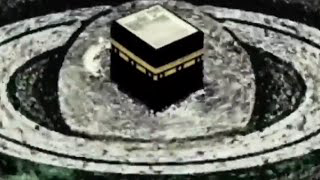
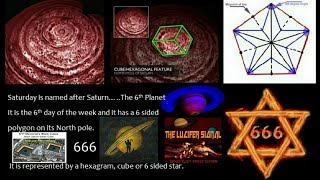
The rings of Saturn and the ritual in which Muslims circle around the Kaaba (the Black Cube) while paying homage to the Black Stone (Hajar al-Aswad) are symbolically reminiscent of the planet Saturn—its hexagonal storm at the pole, the formation and movement of its rings, and its association with the cube in esoteric symbolism.
The term "Satanic Verses" refers to a controversial and widely disputed narrative from early Islamic history. It involves the Prophet Muhammad and alleged verses that appeared to praise three pre-Islamic goddesses, commonly referred to as the "daughters of Allah." These goddesses were named al-Lāt, al-‘Uzzā, and Manāt.
They were worshipped in Mecca before the advent of Islam and are mentioned in Surah an-Najm (Chapter 53) of the Qur’an. According to some early Islamic historical sources—though not the Qur’an itself—during the Prophet’s early preaching in Mecca, he reportedly recited lines that seemed to grant these deities a special status. The alleged phrase was:
"These are the exalted cranes (gharānīq), whose intercession is to be hoped for."
This statement suggested that the goddesses could intercede with Allah, directly contradicting the central Islamic message of strict monotheism. Later, the Prophet is said to have withdrawn the verses, claiming that Satan had deceptively inserted them into the revelation. God then revealed new verses that denounced the pagan goddesses instead.
This event came to be known as the "Satanic Verses" incident—so called because the disputed lines were allegedly whispered by Satan and unintentionally recited by the Prophet.
The Qur’anic Reference
What is actually found in the Qur’an (Surah an-Najm, verses 19–23) is as follows:
“So have you considered al-Lāt and al-‘Uzzā?
And Manāt, the third—the other one?
Is the male for you and for Him the female?
That, then, is an unjust division.
They are nothing but names you have named—you and your fathers—for which Allah has sent down no authority.”
These verses serve as a condemnation, not praise, of the goddesses. There is no mention of “gharānīq” or intercession in the Qur’an itself.
The Daughters of Allah
The phrase "daughters of Allah" originates from pre-Islamic Arab beliefs that these three goddesses were the offspring of Allah, the supreme deity in the Arabian polytheistic tradition. Islam unequivocally rejected this belief.
The Qur’an criticizes the idea in multiple verses, including:
Surah an-Nahl (16:57): “And they attribute to Allah daughters—exalted is He!—and for themselves what they desire.”
Surah as-Saffat (37:149–153): “Ask them if your Lord has daughters while they have sons?”
These verses highlight what Islam viewed as the irrationality and hypocrisy of the prevailing cultural mindset. At the time, Arab tribes preferred sons yet attributed daughters to God—an attitude Islam denounced as both sexist and blasphemous.
#KaabaSymbolism
#SaturnRings
#BlackStoneMystery
#SatanicVerses
#DaughtersOfAllah
#IslamicHistory
#AncientGoddesses
#AlLatAlUzzaManat
#MeccaRituals
#HexagramStorm
#SaturnCube
#QuranicControversy
#PreIslamicArabia
#EsotericIslam
#KaabaAndSaturn
#Islam
#SaturnCube
#Mecca
#Kaaba
Add to
Flag Video
Rate video
Rate video
Up next
Autoplay
Recommended
-
Watch Later
 25:00
25:00Satanic Verses of Islam - The Daughters of Islam - Saturn & Islam
169 views 130 days ago -
Watch Later
 01:22:56
 -
Watch Later
 01:22:56
 -
Watch Later
 01:02:12
Illuminati God SATURN & His Ancient Priests - Saturn in the Bible (NYSTV Clippit)
152 views 130 days ago -
Watch Later
 54:32
54:32 -
Watch Later
 07:11
07:11YAHWEY IS SATURN , SATURN IS SATAN , NSTFU OccultScience101
737 views 1225 days ago -
Watch Later
![Esther as Crypto-Jew: Jewish History, Identity and the Missing 107 Verses from the Book of Esther]() 36:41
36:41 -
Watch Later
!["The Most Hated Bible Verses Defended" by Pastor Steven L Anderson]() 01:08:50
01:08:50"The Most Hated Bible Verses Defended" by Pastor Steven L Anderson
466 views 1605 days ago