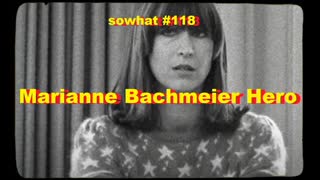
Daughter of Waffen SS, Marianne Bachmeier became famous in Germany after she shot & killed the murderer of her daughter.

QuestionMarkAwareness
Published on Jan 29, 2023
Marianne Bachmeier (3 June 1950 – 17 September 1996) became famous in Germany after she shot and killed the murderer of her daughter in an act of vigilantism in the hall of the District Court of Lübeck in 1981.
Murder of her daughter.
On 5 May 1980, when Anna Bachmeier was seven years old, she had an argument with her mother and decided to skip school. Anna was abducted by Klaus Grabowski, a 35-year-old butcher, whose home she had visited to play with his cats. He held Anna for several hours at his home, sexually assaulted her, and ultimately strangled her.
Marianne Bachmeier grew up in Sarstedt, after her parents fled from East Prussia. Her father had been a member of the Waffen-SS. Her parents divorced, and her mother later remarried.
In 1966, at the age of 16, Marianne Bachmeier had her first child, who she gave up for adoption as an infant. She became pregnant again at the age of 18 by her then-boyfriend. Shortly before the birth of her daughter, Marianne was raped. Her second child was also given up for adoption as an infant. In 1973, Marianne's third daughter, Anna, was born. After Anna's birth, Marianne had a tu left on the bank of a canal. His fiancée turned him in to the police.
Klaus Grabowski was a convicted sex offender and had previously been sentenced for the sexual abuse of two girls. In 1976, he voluntarily submitted to chemical castration, though it was later revealed that he underwent hormone treatment to try to reverse the castration. Once arrested, Grabowski stated that he did not intend to abuse Anna sexually. He said that Anna tried to seduce and extort him, and his fear of going back to prison prompted him to kill her. He said the girl had wanted to tell her mother that he had touched her inappropriately, with the aim of extorting money from him.
On 2 November 1982, Marianne Bachmeier was initially charged in court with murder. Later the prosecution dropped the murder charge. After 28 days of negotiations, the Board agreed on the verdict. Four months after the opening of proceedings she was convicted on 2 March 1983 by the Circuit Court Chamber of the District Court Lübeck for manslaughter and sentenced for unlawful possession of a firearm to six years in prison but was later released after serving three years.
On 6 March 1981, the third day of the trial, Marianne Bachmeier smuggled a Beretta 70[1] into the courtroom of Lübeck District Court and shot the confessed killer of her daughter, Klaus Grabowski, in the back.[2] She aimed the gun at Grabowski's back and pulled the trigger eight times. Seven of the shots hit him, and the 35-year-old defendant was killed almost instantly.[3]
This is likely the most well-known case of vigilante justice in West Germany. It sparked extensive media coverage, and television crews from all over the world traveled to Lübeck to report on this case.
A large part of the population showed understanding for her actions. She sold her life story for about 250,000 Deutsche Mark in an exclusive to the news magazine Stern.
Add to
Flag Video
Rate video
Rate video
Up next
Autoplay
Recommended
-
Watch Later
 00:01
00:01 -
Watch Later
 00:01
00:01SHE WAS TAUGHT IN SCHOOL THAT THE EARTH WAS FLAT - SHE WAS BORN IN 1918 SHE IS A 102
1.4K views 1545 days ago -
Watch Later
 00:01
00:01 -
Watch Later
 04:37
04:37 -
Watch Later
 13:36
13:36 -
Watch Later
![MEET TERRY - SHE TOOK THE DEADLY DEATH SHOT PFIZER AND NOW SHE IS LEFT WITH AUTOIMMUNE DISEASE]() 00:01
00:01MEET TERRY - SHE TOOK THE DEADLY DEATH SHOT PFIZER AND NOW SHE IS LEFT WITH AUTOIMMUNE DISEASE
760 views 1446 days ago -
Watch Later
![MEET DEENA - SHE TOOK THE MODERNA DEADLY DEATH SHOT AND NOW SHE SAYS I LOOK LIKE A MONSTER]() 00:01
00:01MEET DEENA - SHE TOOK THE MODERNA DEADLY DEATH SHOT AND NOW SHE SAYS I LOOK LIKE A MONSTER
764 views 1446 days ago -
Watch Later
![Grieving Uncle Speaks Out At His Nieces Funeral After She Was Killed By A "Vaccine" She Never Wanted]() 00:01
00:01 -
Watch Later
![Angelo Badalamenti & Marianne Faithfull - Who Will Take My Dreams Away]() 06:16
06:16Angelo Badalamenti & Marianne Faithfull - Who Will Take My Dreams Away
185 views 367 days ago